

- Pune's #1 Rated Institute
Full Stack Developer Course in Pune
Envision Institute (ECTI) offers one of the best Full Stack Developer courses in Pune, designed to make you job-ready with real-world development skills.
Our full stack development course covers both front-end and back-end technologies, helping you build complete, scalable web applications. Whether you are a beginner, a graduate, or an IT professional, our full stack developer classes in Pune are structured to give you practical knowledge, confidence, and placement support.
Tools You Will Learn ✨
Frontend Technologies
 HTML5
HTML5 CSS3
CSS3 Bootstrap
 Tailwind CSS
 AngularJS
 ReactJS
 VueJS
VueJS JavaScript
Backend Technologies
 NodeJS
 Laravel
 ExpressJS
 PHP
PHP .NET
.NET C#
C# Java
Java Python
Database & Server
 Apache
 AWS
AWS MySQL
MySQL MongoDB
Project Management Tools
 Slack
Slack Jira
Jira Git
Git GitHub
Version Control
GitHub
Version ControlSkills You Will Develop
Front End
Build responsive, interactive user interfaces.
- HTML5
- CSS3
- JavaScript
- React
Back End
Server logic and REST APIs across all five full stack paths.
- Java
- Python
- Node.js
- PHP
- .NET
Database
Store, query, and manage application data.
- MongoDB
- SQL
- MySQL
AI Tools You Will Learn ✨
 GitHub Copilot
 ChatGPT & GPTs
 Claude AI
 Cursor
 Google Gemini
 Diff Checker
 Grammarly
 Write Human
 Canva AI
 SQL Query Builder
 Whimsical Diagrams
 Wix ADI
Offline + Online available
Bibwewadi Branch
Weekday & Weekend batches
Flexible scheduling
Starts at ₹25,000
Easy EMI available
Lifetime Job Support
Even after placement
Our Students Are Working In


Full Stack Developer Course with Placement Guarantee
Our Full Stack Developer Course in Pune is built for Pune which has 800+ active full stack developer openings on major job portals right now. We offer a complete placement guarantee. Check our Placement Process
You learn what’s required for full stack developer jobs like HTML5, CSS3, JavaScript, React, Node.js, Express, MongoDB, REST APIs, Git along with deployment. At Envision Course we provide technical preparation, mock interviews, resume building, project presentation and company introductions.
Full Stack Course Placements and Reviews
Interview Skills and Placement Support
Technical skills get you to the interview. We make sure you clear it. Every student gets:
-
Mock technical and HR interviews
Practice both technical and HR rounds before you face real hiring panels.
-
Resume and LinkedIn profile optimization
Improve how your profile reads to recruiters and hiring managers.
-
Direct introductions to hiring companies in Pune
Get connected to companies actively hiring through Envision's placement network.
-
₹
Salary negotiation guidance
Learn how to discuss CTC, benefits, and offer terms with confidence.
-
Portfolio and GitHub project reviews
Get feedback on your projects before you share them in interviews.
-
Lifetime job assistance after placement
Continue receiving career support even after you get placed.

- Rena Soft Tech Pvt. Ltd., Baner, Pune
Python Developer
- Name : Sakshi Mohan Powar
- Placed : October, 2026
- College : Shivraj College, Gadhinglaj
- Education : BCS - 2025

- Gephels Systems, Pune
Full Stack Developer
- Name : Swarup Chaudhary
- Placed : October, 2026
- College : IPS Academy
- Education : B.Tech.(Computer) - 2024

- AutomationEdge Technologies, Pune
RPA Developer
- Name : Dhanashree Lomte
- Placed : September, 2026
- College : Sinhgad College of Engineering, Pune
- Education : B.E.(Computer) - 2026

- GoIGNIS Technologies, Haryana
GET( Fire Protection System)
- Name : Rohan Kavale
- Placed : October, 2026
- College : Rajiv Gandhi Engineering College Karjule, Ahilyanagar
- Education : S.Y.B.E.(Mechanical) - 2029

- IRPR Agency, Pune
Software Development Intern
- Name : Pranav Nimbre
- Placed : September, 2026
- College : Sinhgad Academy of Engineering, Pune
- Education : B.E.(Computer) - 2027

- Armament Research and Development DRDO, Pune
Embedded Software Developer (C/C++)
- Name : Shital Ananta Wankhade
- Placed : July, 2026
- College : Vaidhehi Vishnu Saraf Mahavidhyala, Akola
- Education : BCA - 2015

- Eternal BIM Partners Pvt. Ltd.
Trainee BIM Engineer
- Name : Hritik Dashrath Nagrale
- Placed : September, 2026
- College : Dr. Babasaheb Ambedkar Technological University, Lonere
- Education : B.Tech.(Mechanical) - 2022

- Suavis Inc.
Associate Software Engineer
- Name : Shubham Shirsath
- Placed : July, 2026
- College : Nowrosjee Wadia College, Pune
- Education : M.Sc.(Computer) - 2025

- AiDamsole Agile Services Pvt. Ltd., Pune
Full Stack Developer Intern
- Name : Vrushabh Digraje
- Placed : July, 2026
- College : Trinity College Of Engineering And Research, Pune
- Education : B.E.(Computer) - 2026

- AiDamsole Agile Services Pvt. Ltd., Pune
Full Stack Developer Intern
- Name : Rajshri Dipak Bhosale
- Placed : July, 2026
- College : Sinhgad Institute of Technology, Pune
- Education : B.E.(IT) - 2026

- Eibenstock Positron, Pune
Trainee Embedded System Engineer
- Name : Sarthak Pampattiwar
- Placed : July, 2026
- College : G.H.Raisoni College of Engineering & Management, Pune
- Education : B.Tech.(E&TC) - 2025

- Accenture
AASE (Advance Associate Software Engineer)
- Name : Sejal Bajrang Katre
- Placed : June, 2026
- College : Bapurao Deshmukh college of Engineering, Wardha
- Education : B.Tech.(Computer) - 2025

- Sankalp Computers & Systems Pvt. Ltd.
UI/UX Designer and Developer
- Name : Komal Raut
- Placed : July, 2026
- College : PCET's Nutan College of Engineering & Research, Pune
- Education : B.Tech.(Computer) - 2023

- Happiest Mind
Senior Software Developer
- Name : Prathmesh Tambe
- Placed : June, 2026
- College : D.Y. Patil College of Engineering, Pune
- Education : M.Sc.(Computer) - 2023

- Deutsche Bank
Java Developer
- Name : Akshada Popat Dhus
- Placed : June, 2026
- College : D.Y. Patil College of Engineering, Pune
- Education : B.E.(Robotics & Automation) - 2025

- Trataaka Solutions
Web Developer
- Name : Shruti Subhash Dhaktode
- Placed : May, 2026
- College : TSSM BSCOER, Narhe, Pune
- Education : T.Y.B.E.(Computer) - 2027

- Sarvatra Technologies
Software Delivery Team Intern
- Name : Isha Balasaheb Suryawanshi
- Placed : May, 2026
- College : MIT WPU, Pune
- Education : B.Sc.(Computer) - 2025

- Cloud Console
Web Developer Executive
- Name : Shubhangi Tulshiram Thopate
- Placed : April, 2026
- College : Waghire College of Arts, Commerce & Science, Saswad, Pune
- Education : MCS - 2023

- Cognizant
Program Analyst Trainee
- Name : Sanket Ankush Jadhav
- Placed : February, 2026
- College : Bapurao Deshmukh College of Engineering, Sevagram, Wardha
- Education : B. Tech. (Electrical) - 2025

- Accelirate
Trainee-Automation
- Name : Shubhada Wani
- Placed : February, 2026
- College : D.Y. Patil College of Engineering, Pune
- Education : B.E.(Robotics & Automation) - 2025

- Jainam Software
Software Developer
- Name : Omkar Kamathe
- Placed : February, 2026
- College : Vishwakarma University, Pune
- Education : B.Tech.(Computer) - 2024

- Jainam Software
Software Engineer
- Name : Madhuri Datta Kolekar
- Placed : February, 2026
- College : Sarhad College of Arts,Commerce and Science, Katraj, Pune
- Education : M.Sc.(Computer) - 2026

- Jainam Software
Software Engineer
- Name : Shreyas Gorakhnath Kumbhar
- Placed : February, 2026
- College : PCET's Nutan Maharashtra Institute of Engineering and Technology, Pune
- Education : B.E.(Computer) - 2024

- CDAT
Frontend Developer
- Name : Tarun Kishor Patil
- Placed : February, 2026
- College : Ajeenkya DY Patil School of Engineering (SPPU), Pune
- Education : B.E.(Computer) - 2024

- Maruti Suzuki
Digital Sculptor Intern
- Name : Prasad Parkar
- Placed : January, 2026
- College : IAAD, Italy
- Education : B.Des. (Transportation) - 2025

- Gephels System
Trainee Frontend Developer
- Name : Rameshwari Ganesh Mule
- Placed : February, 2026
- College : Sarhad College of Arts, Commerce and Science, Katraj, Pune
- Education : M.Sc.(Computer) - 2026

- Consociate Solutions
Software Developer
- Name : Girish Kesharlal Patil
- Placed : February, 2026
- College : Commerce Management and Computer Science (CMCS), Nashik
- Education : BCA - 2025

- Gephels Systems
Trainee Frontend Developer
- Name : Om Yogesh Pimpale
- Placed : February, 2026
- College : SKN Sinhgad Institute of Technology & Science, Lonavala
- Education : B.E.(Computer) - 2025

- Konecranes and Demag Pvt. Ltd.
GET
- Name : Himanshu Rajendra Nimje
- Placed : January, 2026
- College : Gurunanak Institute of Engineering and Technology, Nagpur
- Education : B.Tech.(E&TC) - 2022

- Orison Infosystem
Full Stack Developer
- Name : Ankita Kanhekar
- Placed : January, 2026
- College : Shri. Shivaji Collage, Parbhani
- Education : BA (Psychology) - 2024

- Webmirchi IT Solutions
Web Developer & Team Leader
- Name : Vishal Vijay Darekar
- Placed : November, 2025
- College : Sarhad College, Katraj, Pune
- Education : B.Sc.(Computer) - 2025

- Guardinger Advanced Technologies
Junior Software Developer
- Name : Vaibhav Balpande
- Placed : January, 2026
- College : Government College of Engineering, Amravati
- Education : B.Tech.(IT) - 2025

- Paarsh Infotech Pvt. Ltd.
Web Developer
- Name : Yash Parag Patil
- Placed : January, 2026
- College : Vishwakarma University
- Education : B.Tech.(Computer) - 2026

- EQL Business Solutions Pvt. Ltd.
Trainee Dot Net Software Developer
- Name : Gaurav Khomane
- Placed : January, 2026
- College : Sharadchandra pawar College Of Engineering: SPCOE, Baramati
- Education : B.E.(Computer) - 2024

- SEPL MEP Consultant Pvt. Ltd.
GET- HVAC Design Engineer
- Name : Anup Kalpalliwar
- Placed : November, 2025
- College : Govt College Of Engineering, Chandrapur
- Education : B.E.(Mech.) - 2019

- Coditron Technology
Junior Web Developer
- Name : Parth Timbadiya
- Placed : December, 2025
- College : Sri Balaji University
- Education : MCA - 2025

- CDAT Pvt. Ltd.
Web Designer
- Name : Gayatri Banugade
- Placed : December, 2025
- College : Arts, Commerce & Science College, Palus
- Education : BCS - 2022

- Gunadhya Software Solutions Pvt. Ltd.
Python Developer
- Name : Shital Zile
- Placed : December, 2025
- College : AMB College, Nagpur, Maharashtra
- Education : MCM - 2022

- Coditron Technologies
Junior Web Developer
- Name : Sunil Sambhaji Shinde
- Placed : December, 2025
- College : Sinhgad Institute OF Management, Pune
- Education : MCA - 2025

- Coditron Technologies
Associate Software Developer
- Name : Suyog Pardeshi
- Placed : November, 2025
- College : Trinity Academy of Engineering, Pune
- Education : B.E.(Computer) - 2022

- Eclerx
Analyst
- Name : Somnath Marshivane
- Placed : October, 2025
- College : College of Computer Science and Information Technology, Latur
- Education : BCS - 2025

- Consociate Solutions
Frontend Developer
- Name : Mrunmai Kudale
- Placed : September, 2025
- College : Fergusson College, Pune
- Education : M.Sc.(Computer)-2023

- GennieSphere Innovations
UI UX Developer
- Name : Shweta Patil
- Placed : September, 2025
- College : Cummins College of Engineering for Women, Pune
- Education : B.E.(E&TC)-2017

- Sycamore Software Solutions Pvt. Ltd.
Junior Software Engineer
- Name : Priyanka Gaikwad
- Placed : September, 2025
- College : Abeda Inamdar Senior College of Arts, Science and Commerce, Pune
- Education : M.Sc.(Computer)-2022

- Sycamore Software Solutions Pvt. Ltd.
Junior UI Developer
- Name : Sahil Jadhav
- Placed : August, 2025
- College : Sarhad College of Arts,Commerce and Science, Katraj, Pune
- Education : B.Sc.(Computer)-2025

- Capgemini
Analyst/A4
- Name : Aditya Garud
- Placed : August, 2025
- College : DY Patil College of Engineering, Kolhapur
- Education : B.Tech.(Comp.)-2024

- DATAMARK, Inc
Data Analyst
- Name : Pranav Said
- Placed : July, 2025
- College : Gramonnati Mandal's ACS College, Narayangaon
- Education : BCA-2025

- Arraylogic Softwares Pvt. Ltd.
Software Development Executive
- Name : Asmita Dhumal
- Placed : July, 2025
- College : Sarhad College of Arts, Commerce, and Science, Katraj, Pune
- Education : B.Sc.(Comp.)-2025

- IBN Technologies Ltd.
SEO Executive
- Name : Vishwajeet Nirmal
- Placed : July, 2025
- College : Yogeshwari Mahavidyalaya, Ambajogai
- Education : BCS-2019

- Infotek Software & Systems Private Limited
Java Developer
- Name : Anushka Terwade
- Placed : July, 2025
- College : K J College Of Engineering & Management Research, Pune
- Education : B.E. Comp - 2024

- P4 Logics Technologies Pvt. Ltd.Sikar
Java Backend Developer in Spring Boot
- Name : Dhruv Mishra
- Placed : July, 2025
- College : Sobhasaria Engineering College, Sikar
- Education : B.Tech -Mech (2021)

- Jade Global Software Pvt. Ltd
Software Developer
- Name : Ronit Sheelwanth
- Placed : July, 2025
- College : Sinhagad Institute of Management
- Education : BCA - 2025

- Coditron Technology
Software Developer
- Name : Umesh Patil
- Placed : July, 2025
- College : R. C. Patel Institute of Technology, Shirpur
- Education : MCA - 2024

- Technical Trade Consultancy
Jr. Web Developer
- Name : Nikhil Honkalaskar
- Placed : July, 2025
- College : Kisan Veer Mahavidyalaya
- Education : B.Sc. (Chem) - 2023

- DataBit Technologies Pvt Ltd.
Project coordinator
- Name : Sahil Mahangade
- Placed : June, 2025
- College : Anantrao Thopte College, Bhor
- Education : BSC - 2024

- Averta Strategy Pvt. Ltd.
Java Full Stack Developer
- Name : Ashitosh Shinagre
- Placed : June, 2025
- College : DY Patil Technical Campus, Kolhapur
- Education : B.Tech - Comp - 2024

- Center for Development of Advance Technology
UI/UX Designer
- Name : Kundan Mahajan
- Placed : June, 2025
- College : Sant Gadge Baba Amravati University
- Education : MCA - 2024

- Virtuebyte Private Limited
Frontend Developer
- Name : Nilesh Bansi Aage
- Placed : June, 2025
- College : Balbhim Arts, Science and Commerce College, Beed
- Education : BCS - 2023

- Cross Country Infotech Pvt. Ltd.
Process Associate
- Name : Vaibhavi Bedkyale
- Placed : June, 2025
- College : Sanjay Ghodawat University
- Education : (B.Tech) in Computer Science - 2024

- Delighteck Labs Pvt Ltd
Frontend developer
- Name : Prasanna Munde
- Placed : June, 2025
- College : Modern Education Society's Wadia College of Engineering Pune
- Education : BE Comp - 2025

- Tata Consultancy Services
System Engineer
- Name : Janhavi Dandavate
- Placed : May, 2025
- College : Dhole Patil college of Engineering, Pune
- Education : BE (Comp) - 2024

- Datagrid Solutions Pvt Ltd
Frontend Developer
- Name : Tanaya Bagaddeo
- Placed : May, 2025
- College : Dhole Patil college of Engineering, Pune University
- Education : B.E. (E&TC) - 2012

- 157 Industries Pvt Ltd
Full stack Java Developer
- Name : Afreen Sanaulla
- Placed : May, 2025
- College : Ness Wadia College of Commerce
- Education : BBA in Finance - 2021

- Embel Technologies pvt Ltd
Embedded Software Engineer
- Name : Anjali Sangode
- Placed : May, 2025
- College : K.D.K.College of Engineering, Nagpur
- Education : B.E (Electronics) - 2020

- CRUXZEN Technologies
Software Developer
- Name : Aditya Garud
- Placed : May, 2025
- College : D.Y. Patil College of Engineering , Kolhapur
- Education : Btech - 2024

- Infosys Ltd
System Engineer
- Name : Saklen Faiyyaj Shikalgar
- Placed : April, 2025
- College : Bharati Vidyapeeth college of engineering, Kolhapur
- Education : B.Tech.(Mechanical) - 2022

- Cognizant
Programmer Analys Trainee
- Name : Sakshi Gujar
- Placed : April, 2025
- College : Zeal College of Engineering,Pune
- Education : B.Tech.(E&TC) - 2025

- Vedh India Advertising Agency
Frontend Developer
- Name : Sudesh Kalokhe
- Placed : April, 2025
- College : D.Y.Patil Technical Campus, Talsande
- Education : B.Tech - 2024

- Tech Mahindra
Associate Software Engineer
- Name : Kasturi Gangakhedekar
- Placed : April, 2025
- College : Shrimati Kashibai Navale College of Engineering,Pune
- Education : BE.(Com) - 2024

- Wipro IT company
Project Engineer
- Name : Sagar Susar
- Placed : April, 2025
- College : Wadia College of Engineering
- Education : BE.(ENTC) - 2024

- Tech Mahindra
Associate Software Developer
- Name : Piyush Devgirikar
- Placed : April, 2025
- College : Trinity College of Engineering and Research ,Pune
- Education : BE.(IT) - 2024

- XDBS Worldwide.Pune
PHP Developer
- Name : Rahul Khairnar
- Placed : April, 2025
- College : Sandip Institute of Engineering and Management
- Education : B.E.(Mechanical) -2021

- Edgemine Technologies
Frontend React Developer
- Name : Prankur Wankhade
- Placed : April, 2025
- College : Sinhgad Academy of Engineering
- Education : B.E. - 2024

- Damsole Technologies
WordPress Developer
- Name : Sahil Walunj
- Placed : April, 2025
- College : Gramonnati Mandal's Arts, Commerce and Science College, Narayangaon
- Education : BCA - 2024

- 360Customizer
Associate Software Engineer
- Name : Om Pimpale
- Placed : April, 2025
- College : SKN Sinhgad Institute of Technology & Science, Lonavala
- Education : BE. Comp - 2025

- CodeSage India Pvt. Ltd.
Full Stack Engineer (MERN Stack)
- Name : Savita Shepur
- Placed : April, 2025
- College : S.M. Joshi College, Hadpasar, Pune
- Education : B.Sc.(Computer)-2024

- BNT SOFT PVT LTD
Java Developer
- Name : Gaurav Chandrakant Patil
- Placed : March, 2025
- College : RC Patel Institute of Management, Research and Development Shirpur
- Education : MCA - 2024

- Cognizant
Programmer Analys Trainee
- Name : Tisha Mehta
- Placed : March, 2025
- College : Sinhagad College of Engineering
- Education : BE.Comp. - 2025

- Zensar Technologies Ltd
Jr.Sostware Engineer
- Name : Mohit Chordiya
- Placed : March, 2025
- College : Sapkal College of Engineering
- Education : BE.(IT) - 2023

- Oerlikon Balzers Coating India Pvt.Ltd.
Web Developer
- Name : Sakshi Katrajkar
- Placed : March, 2025
- College : Vishwakarma College of Arts Commerce and Science
- Education : BSC(Computer Science) - 2023

- Coditron Technologies
Junior Php Developer
- Name : Nilesh Narkhede
- Placed : March, 2025
- College : KCE Society's Institute of Management and Research (IMR Jalgon)
- Education : MCA - 2024

- Gephels System
Trainee Web Developer
- Name : Vishwajeet Salokhe
- Placed : March, 2025
- College : Dr. D. Y. Patil Agricultural And Technical University
- Education : MCA - 2024

- Corditron Technology
Junior PHP Developer
- Name : Sneha Galande
- Placed : March, 2025
- College : SVERI's College of Engineering, Pandharpur
- Education : B.E.(Comp.) - 2024

- ETHDC Technologies
Java Developer Intern
- Name : Aparna Pawar
- Placed : February, 2025
- College : Anantrao Pawar college of Engineering,Pune
- Education : BE - IT 2026

- It cube Solutions PVT limited
Junior Software Engineer
- Name : Riya Mathapati
- Placed : February, 2025
- College : COCSIT college Latur
- Education : BCA - 2023

- Coditron Technologies
Junior PHP Developer
- Name : Neha Rajbhoj
- Placed : March, 2025
- College : Sandip Institute of Technology and Research Centre, Nashik.
- Education : B.E. (Comp) -2023

- Future Tech Design Solutions Pvt. Ltd.
Class A Intern
- Name : Sukanya Thakare
- Placed : February, 2025
- College : Apj Abdul Kalam University
- Education : BE Mechanical - 2024

- Consociate Solution Pvt Ltd
Front End Web Developer
- Name : Sahil Sayyad
- Placed : January, 2025
- College : Vishwakarma College of Arts, Commerce and Science
- Education : M.Sc (Computer Science) - 2023

- Capgemini
Software Developer
- Name : Sakshi Vijay Malvadkar
- Placed : December, 2024
- College : Modern Education Society's Wadia College of Engineering Pune
- Education : BE - 2024

- Future Tech Design Solutions Pvt. Ltd. Gurugram.
Digital Modeler Class A
- Name : Piyush Yadav
- Placed : December, 2024
- College : University of Engineering and Management, Jaipur (Rajasthan)
- Education : B. Tech (Mechanical Engineering) -2021

- Kamjritztex IT solutions
Java Fullstack Web Developer
- Name : Sagar Valunj
- Placed : December, 2024
- Education : BE (IT) - 2023

- Prodmax
UI Developer
- Name : Mayuri Gawade
- Placed : December, 2024
- College : Dr. Dy Patil College
- Education : M.Sc.(Comp.) -2022

- TechnoBridge Systems Pvt Ltd
Fullstack Developer
- Name : Lalit Borase
- Placed : December, 2024
- College : R. C. Patel Institute of Technology, Shirpur
- Education : MCA - 2024

- Cens Data solutions
Embedded Engineer
- Name : Himanshu Nimje
- Placed : November, 2024
- College : Guru Nanak Institute of Engineering and Technology, Nagpur
- Education : B.E.(E&TC) - 2022

- Polite IT Pvt. Ltd.
UI/UX Developer
- Name : Rutuja Narawade
- Placed : October, 2024
- College : VIT Kamshet
- Education : B.E.(Comp.) - 2022

- Brainmine Web Solutions
Junior Web Developer
- Name : Apurva Dandale
- Placed : October, 2024
- College : P.R.Pote College Of Engineering, Amravati
- Education : B.E. (Comp.) - 2023

- Dimakh Consultancy
UI Executive
- Name : Priyanka Shidore
- Placed : October, 2024
- College : VISHVAKARMA INSTITUTE OF ARTS,COMMERCE,SCIENCE
- Education : M.Sc.(Comp.) - 2017

- Dexter Intelligence
Junior Web Developer
- Name : Rushikesh Bodhale
- Placed : September, 2024
- College : BVCOE
- Education : MCA - 2024

- Pjsofttech Pvt. Ltd.
Jr. Java developer
- Name : Kunal Bhade
- Placed : August, 2024
- College : G. H. Raisoni College of Engineering
- Education : B.Tech.(E&TC) - 2024

- Pjsofttech Pvt. Ltd.
Jr. Java developer
- Name : Mustafa Javed Shaikh
- Placed : August, 2024
- Education : B.Tech.(Mech.) - 2021
Upcoming Full Stack Batches
New batches start regularly. Choose a schedule that fits your availability.
Next batch starts on
Starting in
Weekday Batch
Daily sessions for consistent progress and faster completion.
- Classroom & Online
- Faster job readiness
Weekend Batch
Designed specifically for working professionals and current students.
- Saturday & Sunday
- Flexible learning pace
Custom Batch
Start based on demand. Choose your preferred timing and intensity.
- Flexible schedule
- Personal mentorship
Limited students per batch to maintain training quality.
Why Learn Full Stack Development in Pune?
Full stack roles in Pune show hundreds of active job openings, mid‑five‑figure annual salaries for experienced developers, and steady demand across product companies, MNCs and startups.
How many full stack jobs in Pune right now?
As of 2026, these major job portals are advertising openings for full stack developers in Pune. The figures below reflect live listings, so you can click any portal to confirm the current counts.
LinkedIn also shows 26,000+ fullstack developer jobs tied to Pune filters and around 852 Position Full Stack Developer jobs in Pune.
What full stack pays in Pune
A realistic path from entry level to senior as per job portal estimates.
BeBee salary estimate for Pune full stack roles: ₹11.5–18.3 L/year. Jooble calculates an average full stack salary of about ₹12.2 LPA for Pune.
Scope after learning full stack in Pune
Full stack roles are available across different experience levels in Pune. The number of openings and the skills required change as you move from fresher to experienced positions.
Current Indeed fresher full stack listings show opportunities for full stack freshers, junior developers, and trainees. UnoJobs shows fresher full stack developer roles with packages from ₹1–5.5L.
There are 607 full‑time full stack listings on Indeed and hundreds more across Glassdoor, BeBee and Jooble. Postings mention combinations like “React/Next.js + Node.js”, “Java + React/Angular full stack”, and “Python (FastAPI) + React”.
Wellfound shows startup full stack roles with ranges like ₹8–10L for senior full stack developers and ₹21–32L for Java full stack developers with React. Current listings on Shine and Wellfound reflect this experience mix.
Pune as a Full Stack Hiring Hub
Pune has full stack opportunities across MNCs, product companies, banks, SaaS businesses, and IT services firms. Areas such as Hinjewadi, Kharadi, Baner, and Magarpatta have a strong presence of technology and software companies hiring for full stack roles.
Tracked across Built In Pune, Apna and LinkedIn.
Why Full Stack Skills Matter in Pune
When you read job descriptions, “full stack” in Pune almost always means modern frontend plus robust backend plus databases and cloud tools. Full stack skills are used across fintech, insurance, consulting, AI, BFSI, product companies and startups in Pune.
Job‑aligned across multiple stacks on Shine full stack jobs in Pune.
Modern Full Stack Technology Stack
Current full stack roles often require more than basic web development. Employers commonly look for React/Next.js, Angular, JavaScript, REST APIs, Java Spring Boot, Node.js, Python FastAPI, .NET, MySQL, MongoDB, AWS and Git.
Repeated themes on Indeed Full Stack Pune and LinkedIn postings.
Summary: The data points to a clear opportunity. Pune has hundreds of active full stack openings across MNCs, product companies, SaaS businesses, startups, and IT services.
That makes learning full stack in Pune a practical career decision. The goal is not simply to complete a Full Stack Developer Course in Pune, but to build the programming foundation and practical development skills that match the roles companies like Barclays, Accenture, Citi, Cognizant, KPIT and multiple startups list in their full stack job descriptions.
Sources for the data: Indeed · BeBee · Apna · LinkedIn · Glassdoor · Built In Pune · Shine · Scowter · Wellfound · Jooble · UnoJobs
Full Stack Developer Course Learning Roadmap
Stage 1: Frontend
These are used to build the user interface:
- HTML5 : Structure of web pages
- CSS3 : Styling web pages
- JavaScript : Client-side scripting
- Bootstrap / Tailwind CSS : Responsive design frameworks
- React.js / Angular / Vue.js : JavaScript frameworks/libraries for building dynamic UIs
Stage 2: Backend
These handle business logic, data processing, and server communication:
- Node.js (with Express.js) : Popular for JavaScript-based backend
- Java (Spring Boot) : Enterprise-level applications
- Python (Django / Flask) : Simpler, powerful backends
- PHP (Laravel / Core PHP) : Common for small-to-mid web apps
- Ruby on Rails : Elegant and fast development
- .NET (C#) : Microsoft's enterprise web stack
Stage 3: Database
Used for storing and managing data:
- MongoDB Basics : Work with documents, collections and CRUD operations.
- Mongoose : Connect MongoDB with Node.js using schema-based models.
- Data Relationships : Create links between different types of data.
- Validation : Ensure only correct data is stored in the database.
- Database Indexing : Improve data search speed.
Stage 4: Version Control System
Used for code management and collaboration:
- Git : Version control
- GitHub / GitLab / Bitbucket : Code repositories
- Pull Requests : Collaborate on code with others and review changes
- Branch Management : Work on different parts of code without conflicts
- Basic CLI Commands : Use the terminal to manage repositories
Stage 5: Deployment
For deploying and managing web applications:
- Docker : Containerization
- CI/CD Tools : Jenkins, GitHub Actions
- Web Servers : Apache, Nginx
- Cloud Platforms : AWS, Azure, Google Cloud
- Deployment : Heroku, Netlify, Vercel
Stage 6: Deployment and Hosting of Project
Solve issues that happen during deployment.
- Introduction to Deployment : Understand the concept of hosting web apps.
- Netlify & Vercel : Host front-end apps with CI/CD support.
- Render & Railway : Deploy Node.js back-end apps easily.
- Environment Configuration : Set up ports, secrets and variables in hosting platforms.
- Domain Setup : Link your application to a custom domain.
Stage 7: Additional Tools
- RESTful APIs, GraphQL, JSON, AJAX
- Package managers like npm
- Build tools such as Webpack and Babel
- Testing frameworks like Jest
- Development environments like Visual Studio Code
Stage 8: Projects
Students bring these technologies together to build practical full stack applications.
Full Stack Training Course Syllabus
- Java Full Stack – Covers Java, Spring Boot, and Angular or React for robust enterprise-level applications.
- Python Full Stack – Includes Python with Django or Flask, plus essential front-end technologies.
- MEAN Stack – Focuses on MongoDB, Express.js, Angular, and Node.js for modern JavaScript-based development.
- MERN Stack – Offers training in MongoDB, Express.js, React, and Node.js for building dynamic single-page applications.
Hyper Text Markup Language (HTML5):
- Introduction HTML
- HTML Basics
- HTML Elements
- HTML5 Semantic
- HTML Attributes
- HTML Headings
- HTML Paragraph
- HTML styles
- HTML Formatting
- HTML Quotations
- HTML Comments & Colors
- HTML Lists
- HTML Blocks
- HTML Classes
- HTML Layout
- HTML Responsive
- HTML iframes
- HTML Head
Bootstrap:
- Introduction to Bootstrap
- Bootstrap Basics
- Bootstrap Grids
- Bootstrap Themes
- Bootstrap CSS
- Bootstrap JS
Topics:
- Introduction CSS3
- CSS3 syntax
- CSS3 How To
- CSS3 Colours
- CSS3 Backgrounds
- CSS3 Boarders
- CSS Padding
- CSS Height/Width
- CSS3 Gradients
- CSS3 Shadows
- CSS3 Text
- CSS3 Fonts
- CSS3 2D Transforms
- CSS3 3D Transforms
- CSS Links
- CSS Lists
- CSS Tables
- CSS Box Model
- CSS Outline
- CSS Display
- CSS Max-width
- CSS Position
- CSS Float
- CSS Inline-block
- CSS Align
- CSS Combinators
- CSS Pseudo-class
- CSS Pseudo-element
- CSS Navigation Bar
- CSS Dropdowns
- CSS Tooltips
- CSS3 Images
- CSS Attr Selectors
- CSS Forms
- CSS Counters
- CSS3 Animations
- CSS3 Buttons
- CSS3 Pagination
- CSS3 Multiple Columns
- CSS3 User Interface
- CSS3 Box Sizing
- CSS3 Filters
- CSS3 Media Queries.
- CSS3 Responsive
Topics:
- Introduction to jQuery
- jQuery Syntax
- jQuery Selectors
- jQuery Events
- jQuery Effects
- jQuery HTML
- jQuery Traversing
- jQuery AJAX & Misc
Introduction
- What is JavaScript? Complete Introduction with Hello World
JavaScript Concepts and Basics
- Statements
- JS Syntax
- Comments
- Variables
- Operators
- Arithmetic
- Assignment
- Data Types
- Functions
- Objects
- Events
- Strings
- String Methods
- Numbers
- Number Methods
- Arrays
- Array Methods
- Array Sort
- Array Iteration
- Dates
- Date Formats
- Date Get Methods
- Date Set Methods
- Math
- Conditions
- Switch
- Loop For, Loop While
- Type Conversion,
- RegExp
- Errors
- Scope
- Hoisting
- Strict Mode
- this keyword, Let, Const
JS Forms
- How to Script Forms
- Forms API
JS Objects
- Definitions
- Properties
- Methods
- Accessors
- Constructors
- Prototypes
JS Functions
- Definitions
- Parameters
- Invocation
- Call
- Apply
- Closures
JS HTML DOM
- Intro
- Methods
- Document
- Elements
- HTML
- CSS
- Animations
- Events
- Event Listener
- Navigation
- Nodes
- Collections
- Node Lists
JS Browser BOM
- Window
- Screen
- Location
- History
- Navigator
- Popup Alert
- Timing
- Cookies
JS JSON
- Intro
- Syntax
- Json vs XML
- Data Types
- Parse
- Stringify
- Objects
- Arrays
- PHP
- HTML
- JSONP
JS vs jQuery
- jQuery Selectors
- jQuery HTML
- jQuery CSS
- jQuery DOM
Ajax
- Introduction
- XMLHttp
- Request
- Response
- XML File
- PHP
- ASP
- Database
- Applications
- Examples
Introduction
- What is Angular? Why Angular?
- Features of Angular
- Difference between Angular 2, 4, 5, 6, 7
- Required software/tools
- Initial setup
- Creating basic Angular application
- Angular application flow
- Brief description of modules and components
Components in Angular
- Creating component using Angular CLI
- Using component selectors
- Lifecycle hooks
- OnInit, OnDestroy , etc as per requirement
- Component interaction
- Parent & child interaction
Data & Event Binding
- One-way data binding
- Two-way data binding
- Event binding
- Examples in each section
Pipes
- What are pipes?
- Inbuilt pipes
- Custom pipes
- Pure & impure pipes
Directives
- What are directives?
- Types of directives
- Custom directives
Structural Directives
- ngIf – syntax and examples
- ngFor – displaying data dynamically – examples
- ngSwitch – syntax and examples
- ng-container
Attribute Directives
- ngClass – syntax and examples
- ngStyle – syntax and examples
Template Driven Forms
- Introduction
- Basic form with input text field
- Validations – required, maxlength, etc
- Submitting form
- Disabling submit when form is invalid
- Additional input types
- Radio buttons
- Checkbox
- Select dropdown
- Date fields
Reactive Forms
- Need of reactive forms
- When to use reactive and template driven forms
- Basic form with input text
- Form validation
- Additional input types
- Dynamic checkboxes
- Radio buttons
- Select dropdown
Services & HTTP Client
- What is a Service?
- Creating a Basic Service
- What is Dependency Injection?
- Injecting Services
- Using a service in a Component
- Using a shared service
- Angular HTTP Client
- Observable
- Making a basic HTTP GET Call
- GET request
- GET request with parameters
- POST request
- Reading HTTP Response
- Using .map()
- catchError()
- Using the Service in a Component
Routing
- Routing module
- Define routes and add router outlet
- Redirecting
- Lazy loading
- Route guards
- Query parameters
Building & Deployment
- Build the project using ‘ng build’
- Deploy the project
Angular 7 Features
- Unit testing using Karma Essential
- Angular Material Essential
Introduction to React & JSX
- Origins of React
- js Syntax
- Overview of JSX and why you should use it
- Getting hold of everything you need to start coding
React Components
- React component Properties
- Setting Properties
- Component Lifecycle
- Updating Components
- Writing your first React.js component
- Mounting Components
JSX
- Expressions & Attributes
- JSX Basics
- Namespaced Components
- Rendering HTML
- Rendering React Components
Flux
- Views & Controller-Views
- Flux is not MVC!
- Data Flow
- Action, Dispatcher, Store & View
- Flux Application Architecture
- Structure
Event Handling In React
- Key Events
- Event Pooling
- js Event Handlers
- Synthetic Event
Creating a Dynamic UI in React
- Keeping components stateless
- Event Delegation
- React Stateful Components
- Auto binding
Integration with Other Libraries
- Gulp & Browserify
- React with jQuery
- React & AJAX
React Server Integration & Deployment
- httpster
- npm
Do you like the curriculum?
Get Free GuidanceTopics:
- Introduction
- Introduction To Java Programming Environment
- Fundamentals of Java Programming
- Control Structures
- Input Fundamentals And Datatypes In Java
- Object Oriented Programming (Oops Concepts In Deep)
- Command-Line Arguments
- Integrated Development Environment
- Inner Class
- Inheritance
- Abstract Classes and Inheritance
- Polymorphism
- Package
- Using Predefined Package & Other Classes
- New Concepts In Package
- Garbage Collection
- Exception Handling
- Multithreading
- Input and Output Streams
- Serialization
- Collection Framework
Topics:
- An Introduction to Python
- Beginning Python Basics
- Python Program Flow
- Functions & Modules
- Exceptions Handling
- File Handling
- Classes In Python
- Generators and iterators
- Data Structures
- Collections
- Writing GUIs in Python (Tkinter)
- Python SQL Database Access
- Network Programming
- Date and Time
- Few more topics in-detailed
- Regular Expression
- Threads Essential
- Accessing API Essential
- DJANGO Essential
Introduction
- Introduction to JS
- JS evolution to server
- Why to use node?
- How to use node
- Node Package Manager
- Advantages of Node JS
- Traditional Web Server Model
- js Process Model
First Steps
- Node Installation
- what is Express Framework and configuration
- Compilation
- Execution cycle
Exploring Data Types & Functions
- Objects
- Strings
- Numbers
- Auto Casting
- Prototype
- Function
- Self-Invocation Functions
- Array
- Booleans
- Un defined
- null
- Functions
- Buffer
- Module
- Module Types
- Core Modules
- Local Modules
- Module Exports
Control Structures: Logical Expressions
- If statements
- Else and else if statements
- Logical operators
- Switch statements
Control Structures: Loops
- For loops
- For each loops
- Continue
- Break
File System
- Read File
- Writing a File
- Writing a file asynchronously
- Opening a file
- Deleting a file
- Other IO Operations
User-Defined Functions
- Defining functions
- Function arguments
- Returning values from a function
- Multiple return values
- Scope and global variables
Events
- EventEmitter class
- Returning event emitter
- Inhering events
Debugging
- Developers console
- Warnings and errors
- Debugging and troubleshooting
- HTML compilation and Angular Compilation
- Compilation phase
Introduction of Web & PHP
- What is PHP?
- The history of PHP
- Why choose PHP?
- Installation overview
- Embedding PHP code on a page
- Outputting dynamic text
- The operational trail
- Inserting code comments
Exploring Data Types
- Variables
- Strings
- String functions
- Numbers part one: Integers
- Numbers part two: Floating points
- Arrays
- Associative arrays
- Array functions
- Booleans
- NULL and empty
- Type juggling and casting
- Constants
Control Structures: Logical Expressions
- If statements
- Else and elseif statements
- Logical operators
- Switch statements
Control Structures: Loops
- While loops
- For loops
- For each loops
- Continue
- Break
- Understanding array pointers
User-Defined Functions
- Defining functions
- Function arguments
- Returning values from a function
- Multiple return values
- Scope and global variables
- Setting default argument values
Building Web Pages with PHP
- Links and URLs
- Using GET values
- Encoding GET values
- Encoding for HTML
- Including and requiring files
- Modifying headers
- Page redirection
- Output buffering
Working with Forms and Form Data
- Building forms
- Detecting form submissions
- Single-page form processing
- Validating form values
- Problems with validation logic
- Displaying validation errors
- Custom validation functions
- Single-page form with validations
Working with Cookies and Sessions
- Working with cookies
- Setting cookie values
- Reading cookie values
- Unsetting cookie values
- Working with sessions
Building a Content Management System (CMS)
- Blueprinting the application
- Building the CMS database
- Establishing your work area
- Creating and styling the first page
- Making page assets reusable
- Connecting the application to the database
Application CRUD
- Finding a subject in the database
- Refactoring the page selection
- Creating a new subject form
- Processing form values and adding subjects
- Passing data in the session
- Validating form values
- Creating an edit subject form
- Using single-page submission
- Deleting a subject
- Cleaning up
- Assignment: Pages CRUD
- Assignment results: Pages CRUD
Building the Public Area
- The public appearance
- Using a context for conditional code
- Adding a default subject behavior
- The public content area
- Protecting page visibility
Regulating Page Access
- User authentication overview
- Admin CRUD
- Encrypting passwords
- Salting passwords
- Adding password encryption to CMS
- New PHP password functions
- Creating a login system
- Checking for authorization
- Creating a logout page
Advanced PHP Techniques
- Using variable variables
- Applying more array functions
- Building dates and times: Epoch/Unix
- Formatting dates and times: Strings and SQL
- Setting server and request variables
- Establishing the global and static variable scope
- Making a reference assignment
- Using references as function arguments
- Using references as function return values
Working with Files and Directories
- File system basics
- Understanding file permissions
- Setting file permissions
- PHP permissions
- Accessing files
- Writing to files
- Deleting files
- Moving the file pointer
- Reading files
- Examining file details
- Working with directories
- Viewing directory content
Sending Emails
- Configuring PHP for the email
- Sending an email with mail()
- Using headers
- Reviewing SMTP
- Using PHP Mailer
.Net Framework
- CLR, CLS & CTS
- Compilation process in .NET
- Assemblies & Versioning
C#
- Language Syntax
- Data Types, Variables & Operators
- Conditional Statements & Looping Structures
- Garbage Collection and Finalization
- Exception Handling
Classes & Objects
- Classes and Objects
- Abstract Classes and Interfaces
- Constructors and Destructors
- Structures, Enumerations
- Boxing & Unboxing
OOPS
- Encapsulation
- Inheritance
- Polymorphism
- Data Abstraction
Namespace
- Namespace, Nested Namespace
- Delegates & Events
- Properties, Indexer & Indexer Overload
- Errors and Exceptions
Arrays, Collections & Generics
- Single Dimension Array, Multi Dimension Array
- Collections
- Generic Collections
File I/O and Streams
- Working with Directories and Files
- Read and write file
Remoting & Reflection
- Application Domain
- MarshalByRef Object
- Typeof
SQL Server
- Introduction
- DML DDL Functions
- Jins & Views
- Functions & Stored Procedure
- Triggers & Cursors
ADO.NET (Working with Database)
- Overview of NET
- Connected vs Disconnected Architecture
- Data Connection Object
- Data Command Object
- Data Adapter Object
- Data Readers
- Data Sets & Data Adapters
- Structure of Dataset
- Execute Non Query
- Execute Reader
- Execute Scalar
ASP.NET 4.0
- Introduction to Web Programming
- Client / Server Technology
- Understanding Web Server IIS
Page Life Cycle
- asax
- config
- Intrinsic Objects in Net
Web Form
- Web Control Class
- Creating Web Forms Application
- Handling Images
- Navigating between Pages
- Managing Server Controls
- Server Control Events
- Using HTML Controls
- Using Data Controls
- Repeater Control
Validation Controls:-
- Net validation controls
- Configuring validation controls
State Management
- Preserving State in Web Applications
- Using Cookies to Preserve State
- NET Session State
- Application State
User Controls
- Creating User Controls
- Interacting with User Controls
- Loading User Controls Dynamically
Master Pages & Themes
- Simple Master Page Nested Master Page
- Configuring Master Page Creating Themes
- Applying Themes
- Applying Stylesheet
Uploading Files
- Using FileUpload Control
- Setting the location and filename to upload the files
Handling Emails
- Protocols for Email
- Sending Mails
- Managing Attachments
ASP.NET Web Services
- Introduction to XML Web services
- Creating Web Service
- Setting the Web Service Attribute
- Test and Run Your Web Service
- Consuming a Web Service in Client
- Application
- Consuming a Third Party Web service
Deployment
- Publishing Web
- Create a Web Setup
Do you like the curriculum?
Get Free GuidanceMongoDB
- Introduction to MongoDB (No-sql)
- Collections in MongoDb
- Documents In mongoDb
- Difference between Mysql and NoSql
- Inserting data into database
- Filter queries in Mongodb Database
- Schema Validation in MongoDb database
- Indexing In collections
- Aggregation in MongoDb
- Embedded Document in MongoDb
Mysql
Theory, Terminology and Concepts
- Client/Server Concepts
- Database and Database Objects
Data Definition using SQL
- Databases
- Data Types
- Tables
- Constraints and Indexes
- Views
Basic Data Manipulation using SQL
- Recurring SQL Constructs
- Adding data
- Modifying data
- Removing data
- Searching data
Advanced-Data Manipulation using SQL
- Expressions
- Grouping and Aggregate Functions
- Joining Tables
Transactions
- Transaction Concepts
- SQL for working with Transaction
Import/Export
- Tools for Import/Export
- SQL for Import/Export
SQL Server
DBMS introduction
- What is mean by DBMS and its usage?
- Introduction to the relational databases
- Difference between relational and non-relational databases
- Different types of DBS available in the market
- Different version of MS SQL server
SQL introduction
- Why we are using SQL in DBMS?
- What is SQL and introduction to the SQL scripts?
Walkthrough to the SSMS IDE
- Important icons and options in SSMS
- Get to know all the features in SSMS
SQL commands (DDL, DML, DCL, TCL)
- Types of SQL commands
- DDL:
- DML:
- DCL:
- TCL:
Constraints
- Types of SQL constraints
- Primary key
- Foreign key
- Unique key
- Not null
- Default constraint
- Check constraint
Data types in SQL and UDD
- Integer datatypes
- String datatypes
- Date time data types
- UDD-User Defined Data types
Operators in SQL
- Arithmetic operator
- Logical operator
- Comparison operator
Variables in SQL
- Variable definition
- Types of variables
- Local variables
- Global variables
- MS SQL Training Concepts
SQL Joins
- What is meant by joins in sql?
- Types of joins
- Inner join
- Outer join
- Left join
- Right join
- Full join
- Cross join
- MS SQL Training Concepts
Subquery
- What is mean by subquery?
- Types of subqueries
- Independent subquery
- Co related subquery
Table variables
- How to define and create table variables
- Difference between temp tables and table variables in sql ?
Backup and Restore
- Types of back up files
- How to take back and restore in sql?
- How to automate these activities?
Do you like the curriculum?
Get Free GuidanceWhat is a Full Stack Development Course?
A full stack development course is a structured training program that teaches you how to build both the client side (frontend) and server side (backend) of modern web applications, along with databases, APIs, and deployment.
It goes beyond basic web development courses by covering everything from HTML, CSS, and JavaScript to frameworks like React, Node.js, Express, and databases like MongoDB or SQL.
Because companies now prefer multi‑skilled engineers who can ship complete features instead of hiring separate frontend and backend specialists, full stack development course options have become some of the most in‑demand career courses in India.[savvy-it]
What Does "Full Stack Developer" Actually Mean?
Let's start with clarity, because the term is often misunderstood.
A Full Stack Developer isn't someone who knows everything about every technology. It's someone who can independently build a complete working application—from the user interface (what people see) to the backend infrastructure (how data flows and is stored) to the database (where information lives).
The Three Essential Layers
| Layer | What It Does | Technologies |
|---|---|---|
| Frontend | User interface, design, interactivity | HTML, CSS, JavaScript, React, Vue, Angular |
| Backend | Business logic, data processing, security | Node.js, Django, Flask, Spring Boot, PHP, DOT NET |
| Database | Data storage and retrieval | MySQL, PostgreSQL, MongoDB, Firebase |
Full Stack Developer Course vs Web Development Courses
The Limitation
Most generic web development courses stop at HTML, CSS, basic JavaScript, and maybe a frontend framework, preparing you only for UI‑focused roles.
The Full Stack Advantage
A full stack developer course, on the other hand, includes frontend, backend, REST APIs, databases, authentication, deployment, and often cloud/DevOps basics, making you suitable for complete product engineering roles.
Key Skills Companies Expect From a Full Stack Developer - We Teach you These
When recruiters shortlist candidates who have completed a full stack course, they generally look for:
Solid Frontend
HTML5, CSS3, responsive design, modern JavaScript, TypeScript, and a framework like React.
Strong Backend
Node.js + Express or similar, REST API design, error handling, environment variables.
Database Skills
MongoDB or SQL, schema design, relations/embedding, indexing and optimization basics.
Authentication & Security
JWT, password hashing, input validation, secure cookie handling, role‑based routes.
Dev Practices
Git, GitHub, modular code, documentation, testing APIs with Postman.
Your full stack developer classes will be aligned with this checklist from recruiters. [Check Job Openings in Pune]
Full Stack Developer Course Fees
Full stack developer course fees in Pune typically range from around ₹25,000 to ₹60,000 for a 4–8 month, mentor‑led, job‑oriented program, depending on city, batch size, and support level.
Our Modern Full Stack Developer Course Breakdown
Envision Institute's full stack developer course follows a structured learning path that mirrors how modern software products are built—from designing responsive user interfaces to developing secure backend systems, integrating complete applications, optimizing performance, and building AI-powered features.
The curriculum is built around the MERN stack (MongoDB, Express.js, React.js, Node.js), enhanced with Next.js and AI API integration, giving students practical experience with technologies widely adopted by startups and product companies across India.
Curriculum Breakdown
Step-by-Step Learning Path🌐 Phase 1: Frontend Foundations (HTML, CSS, JavaScript & TypeScript)
The journey begins by building a strong foundation in frontend development. Students learn semantic HTML, modern CSS, Flexbox, CSS Grid, responsive design, and create a complete multi-section landing page that reflects real-world website development practices.
The syllabus then progresses to JavaScript and TypeScript, covering variables, functions, DOM manipulation, events, asynchronous programming with async/await, the Fetch API, and modern ES6+ concepts. These concepts are reinforced through a hands-on Task Management Application that stores and manages data using Local Storage.
By the end of this phase, students are capable of building responsive, interactive user interfaces while developing a clear understanding of how browsers process data, handle events, and execute JavaScript.
🛠️ Git, GitHub & React in the Full Stack Developer Course
Version control becomes part of the learning process early in the course. Students learn Git and GitHub, including repository creation, commits, branching strategies, collaboration workflows, and publishing every project to GitHub, allowing them to build a professional portfolio throughout the program.
React.js is introduced next with a strong emphasis on component-based architecture, reusable UI development, props, state management using Hooks such as useState and useEffect, React Router for Single Page Applications (SPA), controlled forms, and Tailwind CSS for building clean, responsive interfaces.
This practical frontend approach prepares students for modern development workflows rather than limiting learning to isolated concepts.
⚙️ Phase 2: Backend Development & APIs (Node.js, Express & MongoDB)
The second phase shifts to backend development using Node.js and Express.js. Students learn the complete request-response lifecycle, routing, middleware, environment variables, API architecture, structured error handling, and backend best practices.
Learning is reinforced through the development of a Blog REST API featuring complete CRUD operations (Create, Read, Update, Delete). Students also learn API testing and debugging using Postman, closely following industry development workflows.
The curriculum then introduces MongoDB and Mongoose, covering schema design, validation, embedding versus referencing, data modelling, and advanced database querying—all essential skills expected from MERN Stack Developers.
🔐 Authentication, Role-Based Access & Application Security
Modern applications require secure authentication systems, and this section focuses on implementing production-ready authentication workflows.
Students build complete authentication systems using JWT, bcrypt password hashing, input validation, sanitization, protected routes, HTTP-only cookies, and role-based access control.
These security concepts prepare students to develop SaaS applications and enterprise-grade web platforms while strengthening the quality of their development portfolio.
🔗 Full Stack Integration & State Management
Once both frontend and backend foundations are complete, students learn how to connect React applications with Express APIs to build complete full stack applications.
The syllabus covers API integration using Axios and Fetch, CORS configuration, authenticated user sessions, frontend state management, loading states, error handling, and user experience improvements that closely resemble production-ready applications.
This phase helps students understand how every layer of a modern application works together instead of treating frontend and backend as separate technologies.
🚀 Phase 3: Next.js & AI Integration
One of the distinguishing features of Envision Institute's full stack developer course is the dedicated focus on Next.js and Artificial Intelligence integration.
Students learn file-based routing, Server Components, Client Components, Server Actions, and understand when to implement Server-Side Rendering (SSR), Client-Side Rendering (CSR), or Static Site Generation (SSG) for improved performance and SEO.
The curriculum extends further into AI-powered application development through OpenAI and Gemini APIs. Students explore prompt engineering, streaming responses, chatbot development, intelligent search systems, AI-assisted content generation, and practical AI integration techniques that are increasingly used in modern software products.
Projects You Build in a Full Stack Developer Course
The course follows a project-first learning approach, enabling students to graduate with practical, portfolio-ready applications that demonstrate real development capabilities. Projects included throughout the syllabus include:
Static Marketing Website (HTML & CSS)
Build a complete multi-section responsive website using Flexbox, CSS Grid, and modern layout techniques.
Task Management Application (JavaScript & TypeScript)
Develop an application featuring task creation, editing, deletion, Local Storage persistence, search functionality, filters, statistics, and advanced array methods including map(), filter(), and reduce().
Blog REST API (Node.js, Express & MongoDB)
Create a production-style backend with CRUD operations, validation, structured error handling, and API testing using Postman.
Complete Authentication System
Implement user registration, login, JWT authentication, password hashing, HTTP-only cookies, and protected routes.
Full Stack MERN Application
Develop a complete application using React, Express, Node.js, and MongoDB with role-based dashboards, authentication, and state management.
Next.js + AI Project
Build an application integrated with OpenAI or Gemini APIs featuring chatbot functionality, intelligent search, or AI-powered content generation.
Every project is designed to strengthen practical development skills while building a professional portfolio aligned with current industry expectations for Full Stack Developer roles.
The Full Stack Ecosystem: Multiple Legitimate Paths
Here's what you need to understand: There is no single "full stack."
Different tech stacks serve different markets, industries, and career trajectories. Choosing one doesn't mean you're wrong if you pick a different one later—but making an informed choice now saves you months of uncertainty.
The Five Major Full Stack Paths Available at Envision Institute
1. Java Full Stack Developer Course
Enterprise GradeWhat It Is: Core Java & Advanced Java + Spring & Spring Boot + REST APIs + Frontend technologies + Database integration
See More Details
- MNC employees and enterprise developers
- Structured, long-term career paths
- Large-scale applications with 1,000+ users
- Banking, insurance, and financial systems
Banking sector, insurance companies, large IT firms (TCS, Infosys, Wipro)
Moderate-to-High (Java syntax is strict; Spring Boot has a learning curve)
- Fresher: ₹5.5 - ₹7 LPA
- 2-5 years: ₹9 - ₹15 LPA
- 5+ years: ₹16 - ₹25+ LPA
Banking platforms, ERP systems, E-commerce platforms.
2. Full Stack Web Development Course
Startup FavoriteWhat It Is: HTML, CSS, JavaScript + React.js + Backend development + Database handling + Deployment basics
See More Details
- Startup environments and product companies
- Single Page Applications (SPAs) with rich user experiences
- Freelancers and remote workers
- Rapid prototyping and MVP development
Startups, SaaS companies, digital agencies, fintech startups
Low-to-Moderate (JavaScript is beginner-friendly; React has gentle learning curve)
- Fresher: ₹5.5 - ₹8 LPA
- 2-5 years: ₹8 - ₹16 LPA
- 5+ years: ₹16 - ₹22+ LPA
Social media apps, Project management tools, Chat platforms.
3. Python Full Stack Developer Course
Data & AI ReadyWhat It Is: Python programming + Web frameworks + Backend logic + Database connectivity + API development
See More Details
- Data-driven applications and analytics
- AI/ML integration in applications
- EdTech platforms with personalized learning
- Rapid application development
EdTech, fintech (AI-powered recommendations), data analytics companies, AI startups
Low (Python is the easiest to learn; Django is very beginner-friendly)
- Fresher: ₹5.5 - ₹7.5 LPA
- 2-5 years: ₹8 - ₹14 LPA
- 5+ years: ₹15 - ₹20+ LPA
EdTech platforms, Analytics dashboards, Recommendation engines.
4. PHP Full Stack Developer Course
Web StandardWhat It Is: PHP fundamentals + Laravel framework + MySQL + Server-side scripting + Web security basics
See More Details
- Small-to-medium enterprises (SMEs)
- Content-heavy websites (blogs, news portals)
- E-commerce platforms (like WooCommerce)
- Budget-conscious businesses
SMEs, local businesses, web agencies, e-commerce platforms
Low (PHP is simple to learn; Laravel makes it modern)
- Fresher: ₹4.5 - ₹6 LPA
- 2-5 years: ₹6 - ₹11 LPA
- 5+ years: ₹10 - ₹15+ LPA
E-commerce sites, CMS, Business portals.
5. Full Stack DOT NET Developer Course
Corporate PowerWhat It Is: C# + ASP.NET + Entity Framework + API development + Database integration
See More Details
- Enterprise applications and corporate systems
- Windows-integrated systems
- Large-scale ERP implementations
- High-security applications
Large corporations, enterprise software companies, government sectors
Moderate (.NET ecosystem is comprehensive but well-documented)
- Fresher: ₹5 - ₹7 LPA
- 2-5 years: ₹8 - ₹13 LPA
- 5+ years: ₹14 - ₹20+ LPA
ERP systems, CRM applications, Financial systems.
Extra Hands-on Projects Includes
Java Full Stack Projects
- Banking Management System
- E-commerce Platform
- Employee Management System
- Social Network MVP
Teaches enterprise-scale thinking, security, and scalability.
Web Development Projects
- Twitter Clone
- YouTube Clone
- Task Management App
- Chat Application
Teaches UX, real-time interactions, and smooth UI.
Python Full Stack Projects
- Educational Platform
- Data Analytics Dashboard
- Recommendation Engine
- Automation Tool
Teaches data-driven thinking and automation.
PHP Full Stack Projects
- Blog Platform
- E-commerce Store
- CMS System
- Business Portal
Teaches practical web business and quick deployment.
.NET Full Stack Projects
- CRM System
- ERP Module
- Real Estate Portal
- Enterprise Dashboard
Teaches enterprise integration and corporate workflows.
Full Stack Course Outcome
Duration: 4+ Months of Intensive, Project‑First Training
Our Full Stack (MERN) Developer – 4 Months Course is designed as a focused, high‑impact roadmap you can realistically complete alongside college or work, without diluting depth.
Every phase has clear timelines, outcomes, and projects, so you always know what you’re building, why you’re learning it, and how it maps to real full stack developer roles in companies.
All students start together with HTML, CSS, JavaScript, TypeScript, Git, GitHub, and React, following the 70‑20‑10 learning rule and building multiple UI and JavaScript projects.
Outcome: You can build responsive UIs, interactive features, and small front‑end applications in vanilla JS/TS and React, and you are comfortable shipping code to GitHub.
Next, you move into Node.js, Express, MongoDB, Mongoose, authentication, and full stack integration, building a Blog API, a complete Auth System, and at least one full MERN stack application.
Outcome: You can design and build end‑to‑end web applications with APIs, databases, login systems, and a modern React frontend—exactly what companies expect from a full stack developer.
In the final technical phase, you add Next.js and AI integration so your profile matches what top product companies and AI‑driven startups are hiring for right now.
Outcome: You can ship SEO‑friendly, high‑performance Next.js apps with AI features like chatbots and smart search, giving you a portfolio that stands out in the full stack developer job market.
In the last leg of the journey, you focus on polishing 2–3 portfolio‑ready projects, code reviews, and refining your GitHub and LinkedIn so they clearly communicate your skills and outcomes.
You also work on mock interviews, resume optimization, and salary negotiation strategies so that you are ready not just to code, but to clear interviews and negotiate confidently.
Placement and career support continue beyond the course, so you always have a mentor to reach out to as you switch roles, stacks, or companies over the next few years.
Why Students Choose Envision Institute
1. Industry-Aligned Curriculum
Updated quarterly based on job postings, alumni feedback, and emerging tech. e.g., Added Docker because 68% of jobs need it.
2. Expert Instructors
Active industry professionals from companies like TCS and Infosys. Not retired teachers.
3. Lifetime Job Assistance
We support you indefinitely with job matches, resume reviews, and upskilling even after you get a job.
4. Personalized Mentorship
Small batches (max 20). Weekly 1-on-1 mentorship. Real project reviews.
5. Cost-Effective
₹45,000 - ₹65,000. Flexible EMI. Money-back guarantee. High value compared to online platforms.
Final Thought: This Is Just the Beginning
Choosing a stack is important, but not life-defining. What matters is your commitment. We teach the technology; you bring the effort.
Envision Computer Training Institute Pvt. Ltd. (ECTIPL) has been training full-stack developers in Pune since 1999. With 10,000+ alumni, we are committed to producing job-ready professionals. Visit Branch for Full Stack Development Course
 Posted on Google
 Deepak ghate
Trustindex verifies that the original source of the review is Google.
GREATPosted on Google shubham puriThe sePosted on Google
 Bhagyashree Chaudhari
Trustindex verifies that the original source of the review is Google.
The session was very informative and easy to understand. The explanation was clear and the examples made the concepts easier to learn. Overall, it was a great learning experience.”Posted on Google Prajyot PoreThe 3 day bootcamp held at TSSM's BSCOER by Envision was insightful and I got to learn some important skills from web dev and data analytics domain. My excel skills surely upskilled. Thank You.Posted on Google
 Sumit IngleBootcamp 5 days cha rahila hota and power Bi include kela pahejPosted on Google
 Bhumika SThe technical seminar was very informative and useful. The speaker explained the topic clearly with practical examples. The seminar helped us gain new technical knowledge and understand its real-world applications. Overall, it was an interesting and valuable learning experience.Posted on Google
 Swarali GadakhThe session was very informative and engaging, with concepts explained in a clear and easy-to-understand way. I really enjoyed the sessionPosted on Google
 Virbhadra M. PatilExcellent bootcamp & expertisePosted on Google
 Priya KarleExcellent.

Get Free Guidance
More About Full Stack

Java Full Stack vs MERN – Which Full Stack Will Help Get a Job Faster in Pune ?

5 LPA vs 25 LPA Full Stack Developer – What’s the Difference

3 Months, 6 Months or 1 Year: How Long Does It Really Take to Become a Full Stack Developer ?

What Do Institutes Actually Teach in a Full Stack Course

How Many ‘Full Stack’ Courses Are There, Really ?

Which Full‑Stack Path To Choose in 2026 – Java, Python, MERN or .NET
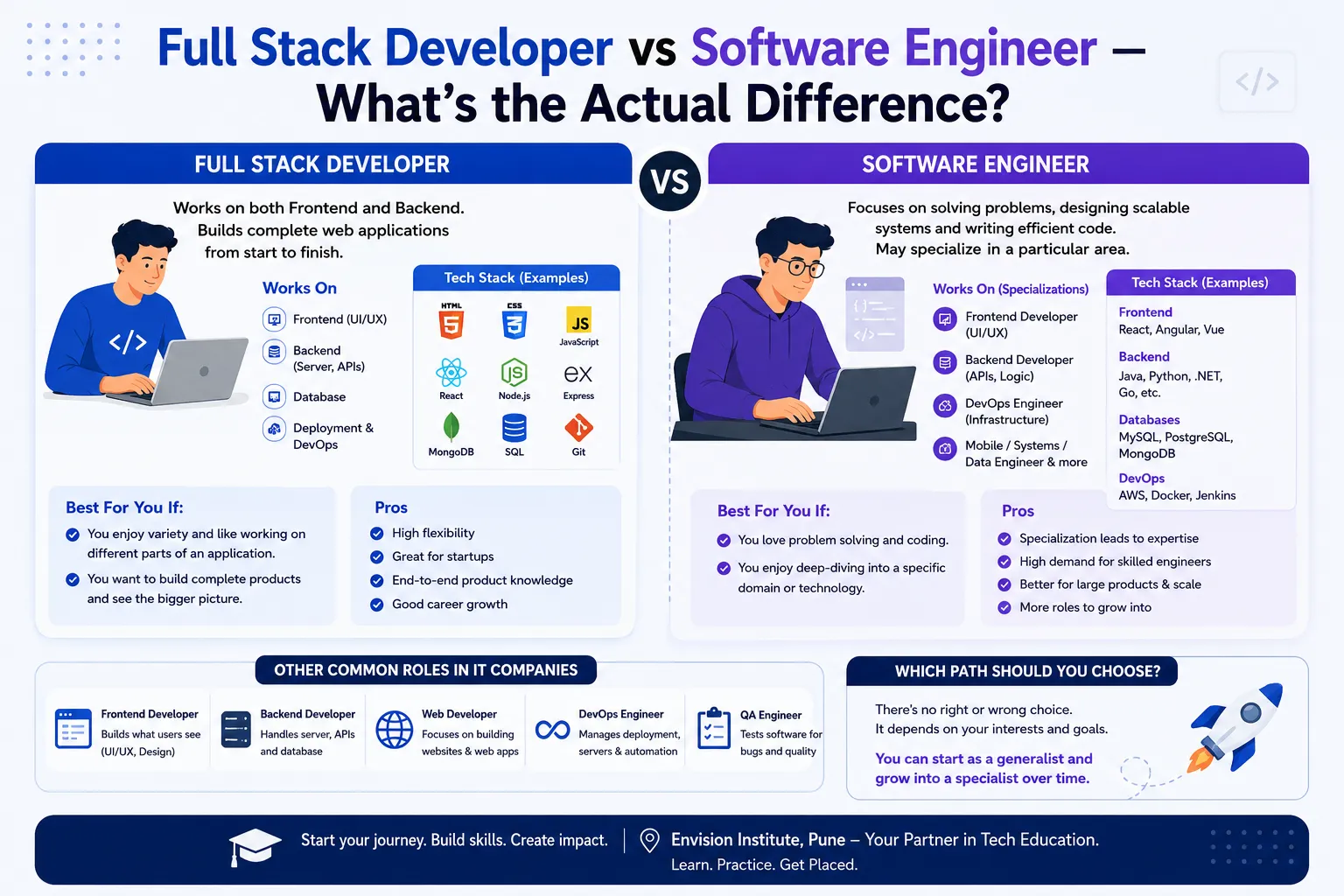
Full Stack Developer vs Software Engineer – What’s the Difference?

The Full Stack Developer Shortage in India: Not About Quantity, About Skills

Is Full Stack Development Still a Good Career in 2026 ?

Is a 5–12 LPA Full‑Stack Salary in Pune Really Possible?

Pay After Placement Full Stack Courses : Real Deal or Risky Bet?

Which is the Best Full Stack Developer Institute in Pune ?

Why Enrolling in Web Development Classes in Pune Can Transform Your Future

How a Full Stack Developer Course in Pune Can Open Doors to Global Opportunities

How Full Stack Classes in Pune Can Launch Your Career

Launch Your IT Career with Placement Support — Full Stack Developer Course in Pune

Why Opt for a Full Stack Developer Course in Pune for a Promising Future

Why a Full Stack Course in Pune is the Smartest Career Move Today

Full stack development course

🚀Our Student Built a Ticket Booking System – Full Stack Development Course in Pune
Ready to Start?
Python
Our Pune Headquarters
Join Pune’s leading IT training ecosystem. Our state-of-the-art campus is designed to provide you with the best learning environment, fully equipped labs, and direct access to industry expert mentors.
Envision Institute
Plot No.3, Yasho Parva, 1st Floor, Shree Sant Eknath Nagar Part I, near Rajarshi Shahu Bank, Bibwewadi, Pune, Maharashtra 411037