

For most students, the confusion is real: job portals show “Full Stack Developer”, “Software Engineer”, “Web Developer”, sometimes with the same salary band and similar descriptions. So what’s the actual difference and which one should you aim for?
Quick answer
A full stack developer is a type of software engineer who builds both the frontend (what users see) and the backend (servers, databases, APIs) of web applications. A software engineer is a broader title for someone who designs, builds and maintains software systems, often specialising in one area like backend, mobile, data, DevOps or systems engineering.
In simple words: all full stack developers are software engineers, but not all software engineers are full stack
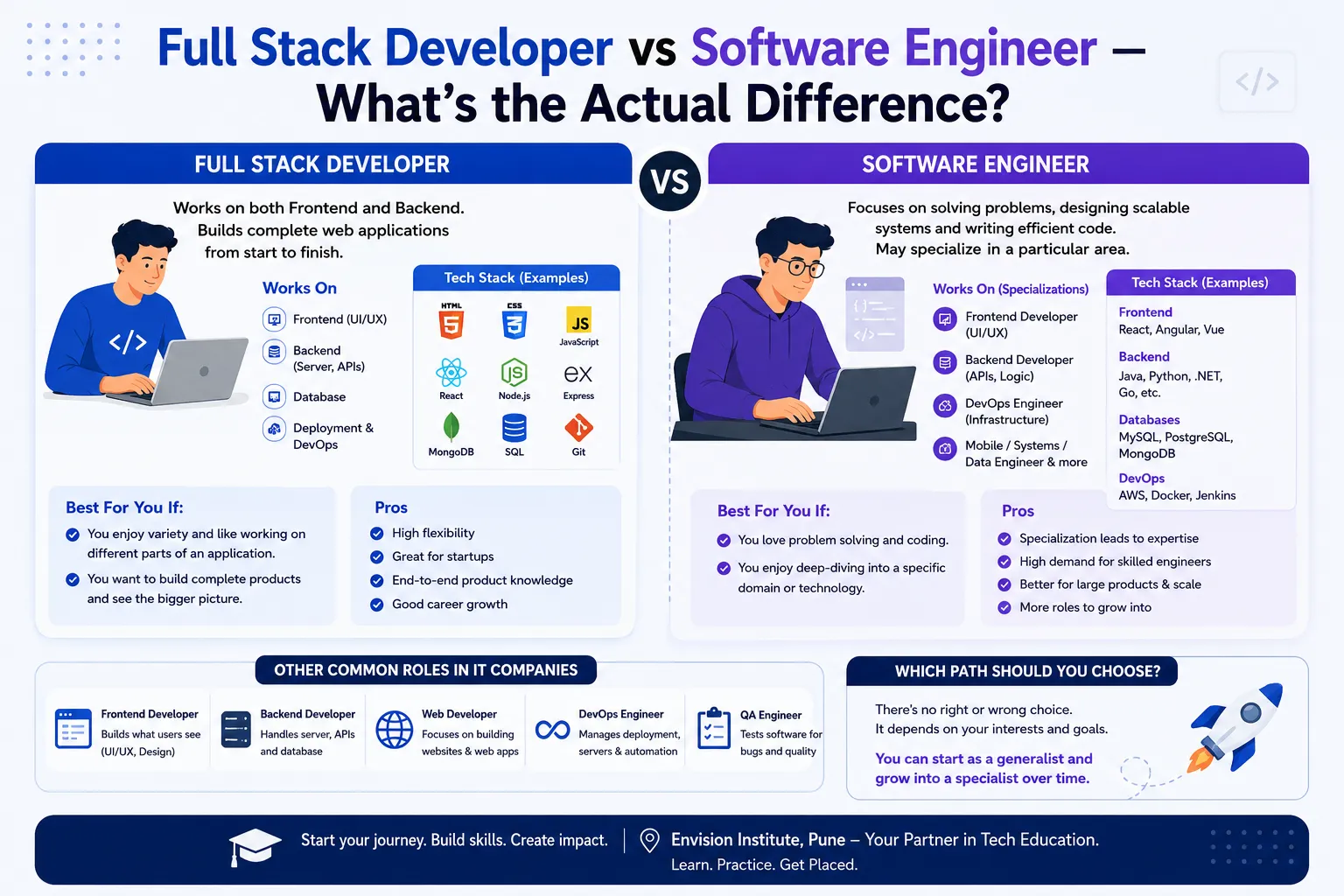
The Comparision
What does a full stack developer do?
A full stack developer works across the entire web stack: user interfaces, server logic, databases, APIs and deployments. They understand how the browser talks to the server, how data is stored, and how everything is stitched together into one working product.
In many companies, full stack developers are valued as “jacks‑of‑all‑trades” who can take a feature from idea to live deployment, especially in startups and product teams.
What does a software engineer do?
A software engineer uses engineering principles to design, build and maintain software systems, not just websites. They might work on backend platforms, microservices, mobile apps, desktop apps, embedded systems or cloud infrastructure, depending on the company and project
They usually focus deeply on one area like backend, data, DevOps or systems design thinking about performance, reliability, scalability and architecture over the long term.
Frontend vs backend vs full stack (roles explained)
In web development, you’ll see three common role types:
- Frontend developer: Focuses on what users see layouts, buttons, forms, responsive design and user experience, using technologies like HTML, CSS, JavaScript and frameworks like React or Angular.
- Backend developer: Works on servers, APIs, databases, security and performance using languages like Java, Python, PHP, Node.js, C# and SQL.
- Full stack developer: Combines both sides, building complete web applications and often handling everything from UI to deployment in the cloud.
Full stack vs software engineer: how companies use these titles
In practice, companies use these titles very loosely, especially in India.
- Some job descriptions call the same role a “Full Stack Developer”, “Full Stack Engineer” or “Software Engineer – Full Stack”.
- Others use “Software Engineer” as a generic title, then specify inside the JD whether the work is full stack, frontend‑heavy, backend‑heavy or system‑level.
This is why many guides say that full stack is basically a special case or subset of software engineering, focused on web applications end‑to‑end.
Software engineer vs developer in India: is there any real difference?
In many Indian IT companies, “software engineer” and “software developer” are used almost interchangeably. From an HR and fresher‑hiring perspective, both titles usually refer to someone who writes code, fixes bugs and contributes to features.
At a more technical level, some companies treat engineers as people who think about architecture and system‑level design, and developers as people who focus more on implementation and building features—but this varies a lot by organisation. For your career, your skills and projects matter far more than the exact title printed on your offer letter.
Which path is better for Indian freshers?
If you like touching everything—UI, APIs, databases, deployments—then a full stack‑oriented path gives you wide exposure and makes you very useful in smaller teams and startups. If you are deeply interested in algorithms, distributed systems or data, then a software engineer role with a backend or systems focus may suit you better over time.
The good news: in India’s current market, both roles have strong demand, and skills are transferable—you can start as a full stack developer and later specialise, or start as a backend engineer and gradually learn the rest of the stack.
How Envision Institute in Pune helps you bridge both
For students in Pune, the real challenge is not choosing a fancy title it’s becoming job‑ready enough to handle whichever role you get. This is where institutes like Envision Computer Training Institute (ECTI) in Pune come in.
Envision has been part of Pune’s IT training ecosystem for many years, offering practical, classroom‑based programs that focus on real projects, not just theory. Their training approach helps you understand both frontend and backend concepts like a full stack developer, while also building the engineering discipline version control, debugging, testing and deployment—that modern software engineer roles expect.
If you’re confused by job titles but clear that you want a serious career in development, learning in a structured, mentor‑driven environment like Envision can help you confidently apply for full stack, web developer and software engineer roles in Pune’s growing tech scen


